If you're sourcing steering shafts for international markets, you've probably been asked this question more than once — and found that the answer is frustratingly inconsistent. Pricing varies so widely across vehicle types, shaft configurations, and supply chains that a single number is essentially meaningless without context. Understanding what actually drives the cost helps you stock smarter and quote with confidence.
A replacement steering shaft typically costs between $40 and $300 USD at the parts level, depending on vehicle application, shaft type, and whether the part is OEM or aftermarket. Intermediate shafts with rag joints for common Asian or European models tend to fall in the $60–$150 range. Heavy-duty or less common applications can push beyond that ceiling.
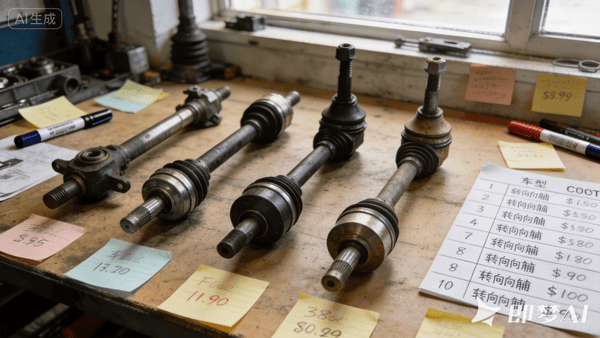
The price range above is a starting point, not a sourcing strategy. What actually determines where a specific part lands within that range — and whether a reported fault even justifies ordering a replacement — takes more careful thinking. Let's work through both questions.
What factors affect steering shaft pricing the most?
Most buyers focus on the unit price. Experienced importers focus on the variables that move that price. Getting clear on those variables is the difference between competitive sourcing and chronic margin erosion.
The price of a steering shaft is shaped by its mechanical complexity, vehicle application, material requirements, and the interfaces it must match. A simple intermediate shaft for a high-volume Japanese sedan is priced very differently from a telescoping column shaft for a European SUV.
Shaft type and mechanical complexity
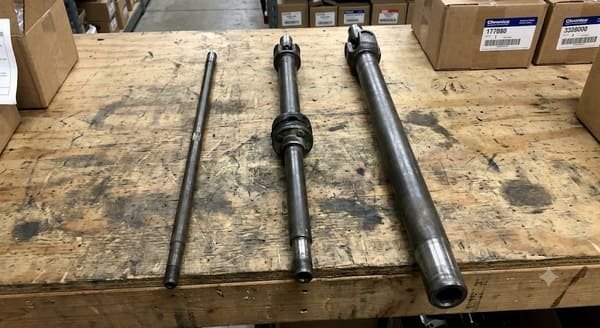
Steering shafts are not a single product category. The major types differ substantially in manufacturing complexity:
- Solid intermediate shafts — simplest construction, lowest cost
- Telescoping intermediate shafts — add a slip joint for length adjustment, moderate cost
- Collapsible column shafts — designed to compress on impact, higher engineering content
- Shafts with integrated rag joints (flexible couplings) — add a rubber disc or fabric coupling element
Each step up in mechanical complexity adds machining time, sub-components, and quality-control requirements. That gets priced into the part.
Vehicle application and production volume
High-volume models — think Toyota Corolla, Nissan Sentra, Hyundai Elantra — generate enough aftermarket demand that tooling costs are amortized across large production runs. Those parts are cheaper per unit.
Low-volume or older models invert that logic. The tooling still costs money. The run quantity is smaller. The per-unit price goes up.
| Application Category | Typical Price Range (USD) | Notes |
|---|---|---|
| High-volume Asian models | $40–$90 | Strong aftermarket supply |
| European mid-range vehicles | $70–$160 | More complex interfaces |
| American trucks/SUVs | $80–$200 | Larger dimensions, heavier duty |
| Low-volume / older models | $100–$300+ | Limited aftermarket tooling |
| Heavy-duty commercial | $150–$350+ | Specialized specs |
Material and surface treatment
Most steering shafts are made from carbon steel or alloy steel. The grade matters. Shafts that interface with U-joints or splined couplings require precise hardness and surface finish tolerances. Shafts with corrosion-resistance requirements — particularly for markets with road salt — need additional treatment, which adds cost.
OEM versus aftermarket positioning
OEM-spec parts carry brand overhead and are priced accordingly. Quality aftermarket parts from manufacturers who control their own production — rather than simply sourcing and relabeling — can deliver comparable dimensional and material specs at a lower price point. The key is verifying the manufacturing process, not just the price.
Does the rag joint condition actually justify ordering a replacement shaft?
This is the question that most pricing discussions skip — and it's the one that causes the most return-related headaches for importers and wholesalers.
A customer reports steering play, a noise, or a delayed response. The rag joint gets blamed. A replacement is ordered. The part arrives, gets installed, and the symptom persists. That cycle is expensive: it wastes sourcing time, generates returns, and damages supplier trust.
Before a replacement part enters your stock pipeline, the fault should be isolated — not just suspected.
Why single symptoms are not enough
From the inquiries we handle at the manufacturing level, the most common pattern in returned parts is this: the customer reported a symptom, assumed the rag joint, ordered the part, and then found the problem elsewhere.
Steering play, for example, can originate from:
- Worn tie rod ends
- Loose or worn steering rack mounts
- Worn column bearings
- Loose fasteners at steering shaft connections
- Worn ball joints (which affect directional stability, often misread as steering looseness)
A loose or degraded rag joint can contribute to play and delayed steering response. But so can most of the components above. Symptom alone is not fault isolation.
What physical inspection of the rag joint actually looks for
When we inspect returned parts or review warranty inquiries, we look for verified physical indicators — not reported symptoms. The difference matters.
Signs that indicate genuine rag joint degradation:
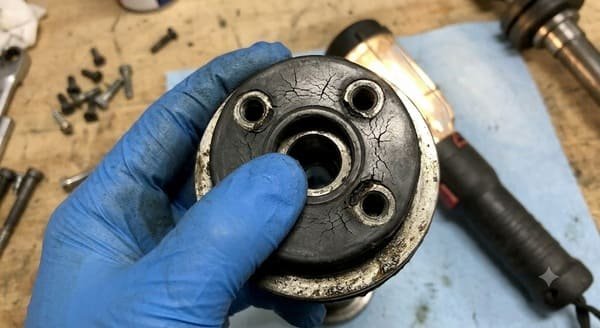
- Visible cracking, splitting, or chunking of the rubber disc
- Delamination of the fabric layers (on fabric-type flexible joints)
- Abnormal compression set — the disc has permanently deformed under load
- Torn or displaced bonding between the rubber and the metal inserts
- Corrosion or fretting at the metal interface points
Signs that do not isolate the fault to the rag joint:
- Steering feels loose (could be upstream or downstream)
- A knock or clunk when turning (requires movement testing at each joint)
- Vibration through the wheel (could be driveline, wheel balance, or worn column components)
The layered check that actually isolates the fault
A structured inspection sequence reduces misdiagnosis. This is not a full workshop procedure — it's a logical framework for understanding whether the reported fault points to the rag joint specifically.
- Visual check first. Look at the rubber or fabric element directly. Is there physical evidence of failure? Cracks, tears, distortion, hardening?
- Check the fasteners. A loose through-bolt or pinch bolt at the rag joint connection can create play and noise that mimics joint degradation. This is one of the most frequently overlooked causes.
- Assess movement at the connection. With the vehicle stationary and the steering unlocked, check for abnormal axial or radial movement at the joint itself — not at the wheel. Movement at the wheel doesn't tell you where the slack is.
- Rule out adjacent components. Check the universal joints above and below the flexible coupling. Check rack mounts and column mounts. If multiple points have play, you haven't isolated the fault yet.
- Refer dynamic loading to a qualified technician. If confirming the fault requires the steering system to be under load or the vehicle to be in motion, that assessment should be done by a qualified mechanic — not inferred from a customer's description.
The stocking implication for importers and wholesalers
Diagnosis quality directly affects inventory decisions. From a sourcing perspective, the goal is not just to have a part available — it's to order the right part for a confirmed fault.
Before placing a replenishment or new order based on a field return or customer complaint:
- Confirm which component actually failed. Was it the rag joint? The U-joint? A fastener? The column shaft?
- Verify the vehicle application. Year, make, model, and trim level — not just "it looks similar."
- Check the interface specs. Spline count, shaft diameter, bolt pattern, and overall length must match. A physically similar shaft with the wrong spline count will not install correctly.
- Match the part number. Use OEM cross-reference data or a verified fitment catalogue, not visual similarity alone.
Getting this right at the sourcing stage reduces returns, prevents incorrect fitment complaints, and protects your relationship with downstream repair networks.
How does shaft configuration affect compatibility and replacement cost?
Compatibility errors are one of the most common causes of returns in the steering-shaft category. Two shafts can look nearly identical and be completely non-interchangeable.
The shaft's configuration — its connections, geometry, and motion range — must match the vehicle precisely. Mismatches create installation failures, and in some cases, unsafe steering behavior. This is a manufacturer's concern as much as a buyer's concern.
Critical fitment dimensions
| Dimension | Why It Matters |
|---|---|
| Spline count and diameter | Determines whether the shaft seats correctly in the column or rack |
| Overall length | Affects whether the joint sits in the correct operating angle |
| U-joint cross size | Must match the adjoining shaft or column yoke |
| Rag joint bolt pattern | Bolt circle and hole count must match the column flange |
| Telescoping travel range | Relevant for collapsible or adjustable shafts |
Why "fits similar vehicles" is not good enough
A Toyota and a Hyundai from the same year may use shafts with the same general dimensions but different spline specifications. A model mid-cycle refresh may change the shaft interface without changing the model name. Always verify against the specific application, not a general category.
In our production and quality process, every part number is tied to a specific vehicle application matrix. When customers provide incomplete application data, we ask for clarification before confirming a part. That step prevents fitment errors downstream.
Frequently Asked Questions
Is a $40 steering shaft reliable enough for professional resale?
Price alone doesn't answer that question. What matters is the manufacturing process, material specification, and dimensional accuracy. A low-priced shaft from a manufacturer with controlled production and documented quality checks can be more reliable than a higher-priced part from an unverified source. Ask for material certs and inspection records before committing to volume.
How do I know if the rag joint is the failed component, not the U-joint?
Physical inspection is the starting point. Rag joint failure typically shows visible rubber degradation — cracking, tearing, or permanent deformation. U-joint failure more often presents as binding, grinding, or roughness through specific steering angles. If you cannot isolate the fault visually and by checking movement at each connection separately, refer the vehicle to a qualified technician.
Can I source just the rag joint separately, or do I need the full shaft assembly?
Both options exist in the market. Standalone rag joints (flexible couplings) are available for some applications and can be cost-effective when the shaft itself is undamaged. However, assembly fitment must be verified. For high-volume models, full shaft assemblies with the rag joint integrated are often more practical for aftermarket supply chains.
What information do I need to give a steering shaft supplier for an accurate quote?
At minimum: year, make, model, trim level, and the OEM part number or cross-reference number if available. For accurate fitment confirmation, shaft length, spline specifications, and U-joint cross size are also useful. The more specific the application data, the fewer errors occur in the sourcing process.
Why do some steering shafts cost significantly more than others for the same vehicle?
Differences in material grade, surface treatment, production tolerances, and quality-control processes all affect cost. Brand positioning and distribution margins also play a role. The most reliable approach is to compare specifications directly — not just prices — and request documentation that supports the manufacturer's quality claims.
Conclusion
Steering shaft costs range widely because the product category itself is wide. Vehicle application, shaft type, mechanical complexity, and supply chain positioning all shape the final price. For importers and wholesalers, the more important discipline is matching the right part to a confirmed fault — not just responding to a reported symptom. A structured inspection approach, precise fitment verification, and clear communication with your supplier reduce returns, protect margins, and build the kind of reliability that downstream repair networks depend on. If you're evaluating steering shaft suppliers or need application-specific pricing, reach out to our team at Wan'a Auto Parts — we're here to support your sourcing decisions with the technical detail your customers expect.
Leave a Reply